Note: This opinion piece represents my personal views and not those of any group with which I am affiliated. It reflects a good faith effort to present all facts, context, and data accurately and fairly.
Update: Since publishing this opinion piece, I’ve learned that some people are claiming that the five members of the APA’s Collaborative of Jewish Psychologists mentioned here did not want APA’s accreditation status to be suspended or terminated. I don’t find that claim credible, and I now offer further evidence here.
Last week, the National Advisory Committee on Institutional Quality and Integrity (NACIQI) overrode guidance from Department of Education staff and recommended that the federal recognition of the American Psychological Association Commission on Accreditation (APA-CoA) be suspended for one year, over alleged failures to address antisemitism.[1] A statement from the APA-CoA noted that, if this suspension is upheld, it could have “real and lasting consequences for psychology programs, future psychologists, and the nation’s mental health,” including current psychology graduate students whose training depends on federal grants.
This is clearly a very disturbing development on multiple fronts. But here I want to focus on one significant concern in particular: the fact that the committee’s decision reportedly turned on brief condemnatory third-party testimonies from several psychologists, including Miri Bar-Halpern, Cassie Feldman, Daniel Hoffman, Dean McKay, and Joshua Simmons.
Most of these individuals had previously signed a letter accusing the APA of “virulent” and “systemic” antisemitism, based predominantly on some members’ criticisms of Israel and expressions of distress and outrage over the genocide in Gaza. Nevertheless, despite this and other actions that appear to involve their weaponization of antisemitism,[2] last year they were appointed to a new group — the “Collaborative of Jewish Psychologists” (CJP).[3] — by the APA Board of Directors. In announcing CJP’s launch in July 2025, APA’s Office of Psychology in the Public Interest specifically highlighted that the group would “work in partnership with APA leadership to co-develop meaningful strategies for combating antisemitism and elevate Jewish identity” (emphasis added).[4]
But given their decision to testify publicly in a government hearing in support of highly consequential punitive action against the APA, in my view these five CJP members have betrayed any semblance of “partnership” with APA’s leadership. And in light of this shattered trust, I don’t see how the CJP can credibly continue its work if these individuals remain among its members.
All the more troubling is that fact that a press release from the Brandeis Center for Human Rights Under Law — issued immediately after the vote in favor of suspension — appears to list these five CJP members as clients. To me, this is a stunning revelation. The Brandeis Center — closely aligned with the Trump Administration in its opposition to academic freedom and DEI initiatives — is the organization that, earlier this year, filed a complaint against the APA with the Department of Health and Human Services, alleging widespread antisemitism and prompting the current HHS civil rights investigation of the APA. I don’t know how long these CJP members may have been Brandeis Center clients, or whether that relationship may have existed before they even accepted the invitation to work in partnership with APA’s leadership as members of the CJP.
Regardless, in my opinion, all pretense has now evaporated that the primary commitment of these individuals is to assist, rather than undermine, the APA. As a result, I think it’s clear that APA’s Board of Directors and Council of Representatives — as well as the leaders and other members of the CJP — have important choices to make. Among them is the removal of these five individuals from the CJP or the en masse resignation of CJP’s members and leaders who reject their seeming duplicity.
I believe that to simply ignore what appears to be a disturbing betrayal would amount to complicity or a shameful prioritization of political expediency over principled ethics. I’ve seen this before. I hope it doesn’t happen again.
[1] Prior to the meeting, the APA-CoA had received only two formal complaints about antisemitism among the 1,300 programs it accredits.
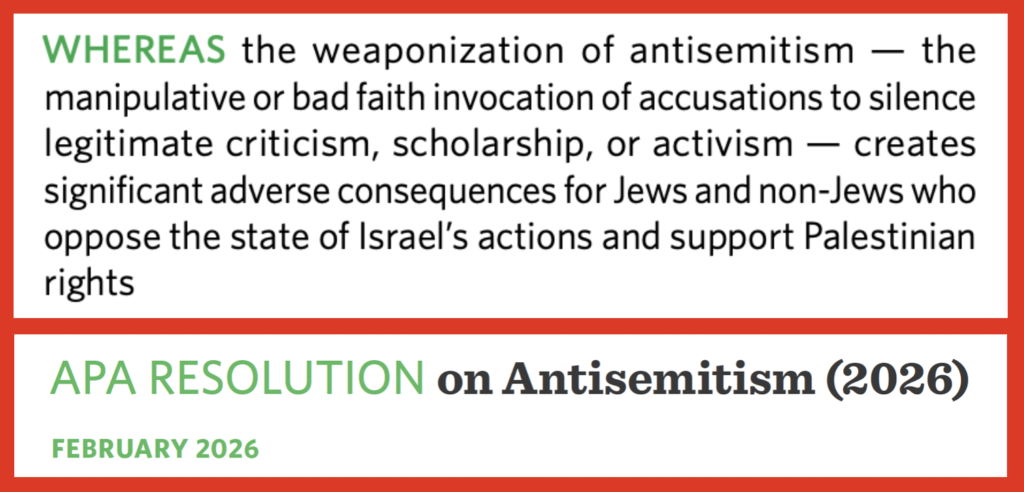
[2] According to the APA’s 2026 Resolution on Antisemitism, this weaponization is “the manipulative or bad faith invocation of accusations to silence legitimate criticism, scholarship, or activism.”
[3] Most (and possibly all) of these five individuals are also members of both the “Association of Jewish Psychologists” and “Psychologists Against Antisemitism.”
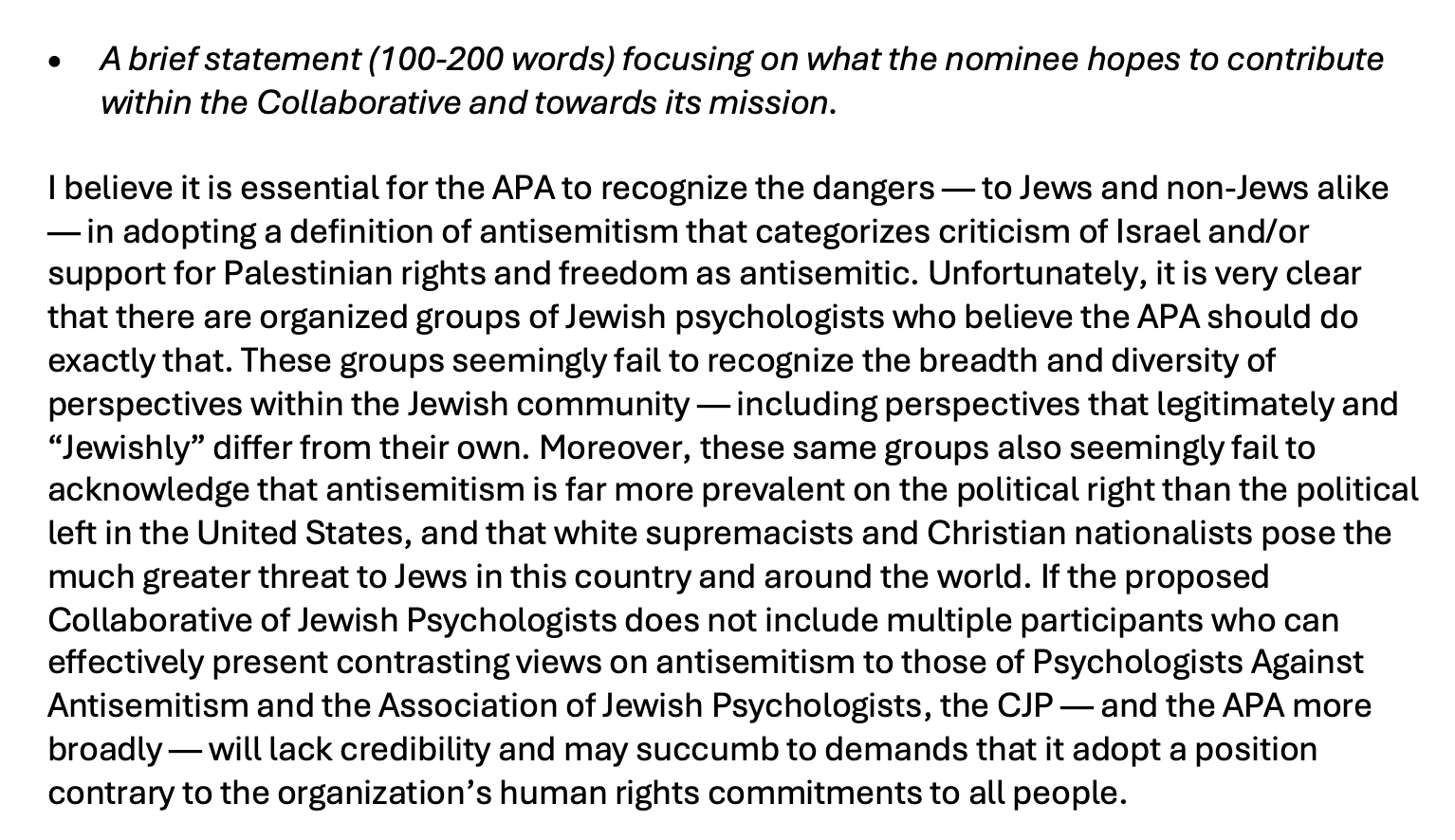
[4] Full disclosure: I submitted an unsuccessful application to become a CJP member (my personal statement is available here) and I’ve previously expressed significant concerns about the composition of the CJP.